June 9, 2026 • Steve Dawson • 8 min reading time • Prices verified June 25, 2026
First Pearl Necklace Gift Guide: How to Spend $160–$400 on Something She'll Actually Keep
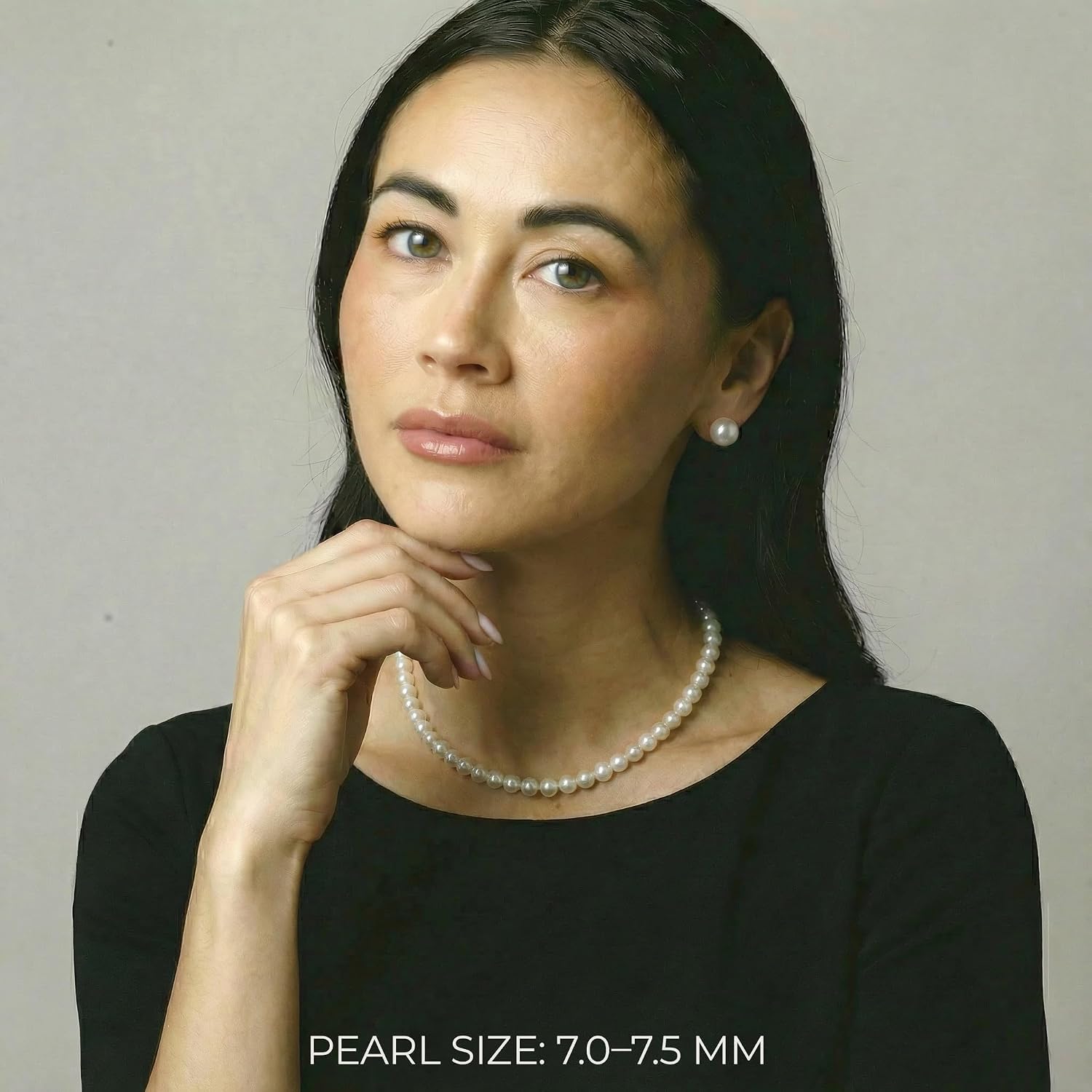
You already know what a pearl necklace is. What you’re wrestling with right now is whether the one you’re looking at is actually worth the price — and whether she’ll reach for it in five years or leave it in a box. That’s the real question at $160–$400, and it’s a sharper question than most gift guides admit.
At this price tier, you’re shopping primarily in Akoya cultured pearls (saltwater pearls grown in Japanese and Chinese oysters, typically 6–8mm in diameter, known for sharp, bright luster) and freshwater cultured pearls (grown in Chinese mussels, available in a wider size range and color palette, generally priced lower for equivalent size). Both are real pearls — the “cultured” designation means a human-inserted nucleus started the process; the oyster or mussel still grows the nacre (the crystalline coating that gives pearls their glow) naturally. The difference in price comes down to nacre thickness, consistency, and origin — not some artificial quality tier invented by marketers.
Here’s what this guide will do: walk you through the tradeoffs that actually matter at this budget, name the numbers you should be comparing, and give you a clear decision rule so you can stop second-guessing.
| EDITOR'S PICKTahitian Black Pearl/Akoya Whit… | Mid-tier[The Pearl Source Real Freshwate…](https://www.amazon.com/dp/B06XTV4DNW?tag=greenflower20-20) | Budget pick[VIKI LYNN Freshwater Cultured P…](https://www.amazon.com/dp/B00CW8SZE6?tag=greenflower20-20) | |
|---|---|---|---|
| Pearl Type | Tahitian + Akoya | Freshwater | Freshwater |
| Grade | AAAA+ | — | — |
| Metal | 18K Gold | Sterling Silver | — |
| Included Items | Pendant necklace | Necklace only | Necklace + bracelet + earrings |
| Clasp Type | — | Fishhook | — |
| Price | $389.97 | $333.60 | $159.99 |
| See on Amazon → | See on Amazon → | See on Amazon → |
The $160–$400 Range: What’s Actually Available, and What the Gap Means
This budget splits into two distinct zones, and understanding the gap matters.
$160–$250: Freshwater-dominant territory. At this price, you’ll find 7–8mm freshwater strands in white, pink, or lavender from retailers like Pearl Paradise and The Pearl Source. Quality varies widely. The best in this range — AA or AA+ graded — will have genuine luster (you can see a reflection in the surface, not just a shine) and minimal surface spotting. The worst are chalky, dull, and overpriced for what they are.
$250–$400: The Akoya entry point and premium freshwater. Around $280–$400, you start seeing genuine Akoya strands in the 6–6.5mm range from reputable specialty retailers. These are saltwater pearls with thicker, more uniform nacre than most freshwater in this price band. Luster is typically stronger and more directional — the reflection you see in an Akoya looks like a tiny light source, not a diffused glow. The Pearl Source’s published grading notes distinguish this as “sharp luster” vs. “soft luster,” and it’s visible in side-by-side photos.
You can also find 7.5–8mm AAA freshwater strands at the top of this range from established retailers. For many buyers, a well-matched AAA freshwater at $320 is a better gift than a baseline Akoya at $380, because size and surface perfection can matter more to the recipient than pearl type.
By the numbers:
| Pearl type | Typical size (this budget) | Luster grade available | Approx. price range |
|---|---|---|---|
| Freshwater AA | 7–8.5mm | Soft to medium | $160–$260 |
| Freshwater AAA | 7.5–8mm | Medium to sharp | $280–$380 |
| Akoya (entry) | 6–6.5mm | Sharp | $300–$400 |
The Three Quality Signals That Survive the Gift Box
When a pearl necklace is a gift, it gets evaluated twice: once when she opens it, and again every time she wears it. Here are the three attributes that hold up under both scrutinies.
1. Luster — The One That Matters Most
Luster is the depth and sharpness of light reflection from the pearl’s surface. It’s not the same as shine — a plastic bead can be shiny. Luster means you can see a slightly distorted reflection of a window or a light fixture in the pearl itself.
The GIA’s pearl description framework identifies luster as the single most important value factor in a pearl. Their published grading criteria (available at gia.edu) rate it on a scale from Excellent down to Poor. At this budget, you’re targeting at least “Good” — and ideally “Very Good” or better.
Why does it matter for a gift? Because dull pearls look cheap even when they’re not, and strong luster holds up to casual wear without the necklace looking like it’s faded. Owners across aggregated reviews consistently note that luster is the first thing non-jewelry people notice and comment on.
What to look for in product photos: Zoom in on the main pearl. Can you see a crisp, slightly distorted reflection? That’s good luster. If the surface looks uniformly glowing with no distinct reflection, you’re looking at soft luster — acceptable but not exceptional.
2. Surface — The “Wearable” Threshold
Pearl surface grading refers to the presence or absence of blemishes: bumps, spots, wrinkles, or flat patches on the nacre. No pearl is perfectly clean, and anyone claiming otherwise is either selling a very small number of cherries-picked pearls or exaggerating.
The practical threshold for a gift necklace: surface flaws should not be visible when worn. That usually means AA or better on a freshwater strand, where minor inclusions are present but concentrated away from the face of each pearl. GemSociety.org’s pearl value factors guide describes this as “eye-clean” — not laboratory-clean, but genuinely lovely to look at in normal light.
Avoid anything marketed as “A” grade without further qualification at this price point. Some retailers use “A” to mean premium; most use it to mean the bottom of their scale. The Pearl Source’s grading guide clarifies that their A-grade is their lowest offered tier, with visible blemishes covering more than 20% of the surface.
3. Matching — The Necklace-Level Variable
Individual pearl quality matters. But for a strand, matching is the variable that separates a necklace that photographs beautifully from one that looks pieced together. Matching covers size consistency (pearls should be within 0.5mm of each other for a classic strand), color consistency (all warm-white, not some warm and some pink), and shape consistency (all round or near-round, not mixed with obvious off-rounds).
Pearl Paradise’s buying guide notes that matching is one of the most labor-intensive parts of strand assembly and a significant cost driver at the upper end of any price tier. At $300–$400, look for strand photos that include a side view, not just a flat lay — that’s where mismatched sizes show up.
Retailer Reality Check: Who’s Worth Your Money at This Budget
You’re not buying this from a department store. At the $160–$400 price point, department store pearl necklaces frequently offer poor luster in attractive packaging at a significant brand markup. Independent specialty retailers consistently provide better pearl quality per dollar.
The retailers that come up most reliably in this range — based on aggregated buyer reviews and published grading transparency — are:
Pearl Paradise (pearlparadise.com): Strong reputation for luster-forward grading and honest product photography. Their entry Akoya strands and AAA freshwater options are frequently cited by buyers as punching above their price tier. Their blog provides genuinely useful grading comparisons.
The Pearl Source (thepearlsource.com): Competitive pricing and clear grading documentation. Their published grading guide is one of the more transparent in the industry, which makes it easier to comparison-shop. Reviewers note reliable packaging and strong customer service on exchanges.
Honora and similar accessible brands: Available through major retailers, suitable if the recipient values recognizable branding. Expect to pay a modest premium for that, and know that luster quality is generally solid but not exceptional at their entry price points.
For the gift tier specifically, the American Gem Society recommends prioritizing retailers who publish their grading criteria and offer return windows of at least 30 days — because luster especially is something you can only fully evaluate in-hand.
The Clasp and Chain: Where Cheap Necklaces Give Themselves Away
The pearl quality can be excellent, and the necklace can still feel like a cheap gift because the clasp is flimsy or the silk cord knotting is uneven. At $160–$400, look for:
- Sterling silver or 14K gold-filled clasp, not rhodium-plated zinc. The clasp is what she touches every time she puts it on. Buyers consistently report that a clasp that feels lightweight undermines confidence in the entire piece.
- Hand-knotted silk cord between each pearl. Knotting serves two purposes: it prevents pearls from rubbing against each other (protecting nacre) and keeps the strand from completely unraveling if the cord breaks. Most quality retailers in this range hand-knot as standard; verify before purchasing.
- Strand length appropriate to how she dears jewelry. The standard 16-inch strand (choker-adjacent, sits at the collarbone) is classic but not universally flattering. An 18-inch strand sits lower on the collarbone and works for more necklines. If you’re not sure, 18 inches is the safer default for a gift.
The Decision Rule
Here’s where this lands:
If your budget is $160–$240 and you want something genuinely wearable: Buy a 7–8mm freshwater strand in AA+ or AAA from a specialty retailer with published grading and a return policy. Do not buy based on photos alone without zoom capability on the pearls themselves.
If your budget is $250–$350 and she wears jewelry regularly: Step up to AAA freshwater at 7.5mm+ or an entry Akoya at 6mm. The luster difference is visible in everyday lighting, and it’s the kind of thing she’ll notice on herself without being told what to look for.
If your budget is $350–$400 and this is meant to be a lasting piece: The 6.5mm Akoya range from a specialty retailer is the honest answer. It’s the smallest size where Akoya luster is genuinely exceptional, and at this price you’re getting the kind of pearl quality that gets passed down — not upgraded in three years.
One honest tradeoff to name explicitly: a larger, slightly lower-luster freshwater strand looks more impressive in the box. A smaller, high-luster Akoya looks better when worn. For a gift, know your recipient: does she care about visual impact at the moment of opening, or about how something feels and photographs when she’s dressed?
Either answer is the right answer. The gift fails when the buyer doesn’t ask the question at all.
Grading frameworks referenced in this guide: GIA Pearl Description overview (gia.edu); The Pearl Source Pearl Grading Guide (thepearlsource.com/blog); Pearl Paradise How to Buy Pearl Jewelry (pearlparadise.com/blogs); American Gem Society Pearl Buying Guide (americangemsociety.org); GemSociety.org Pearl Value Factors (gemsociety.org).