June 4, 2026 • Steve Dawson • 8 min reading time • Prices verified June 25, 2026
Akoya Pearl Stud Earrings: Reading Grade Claims Before You Pay $120 to $370
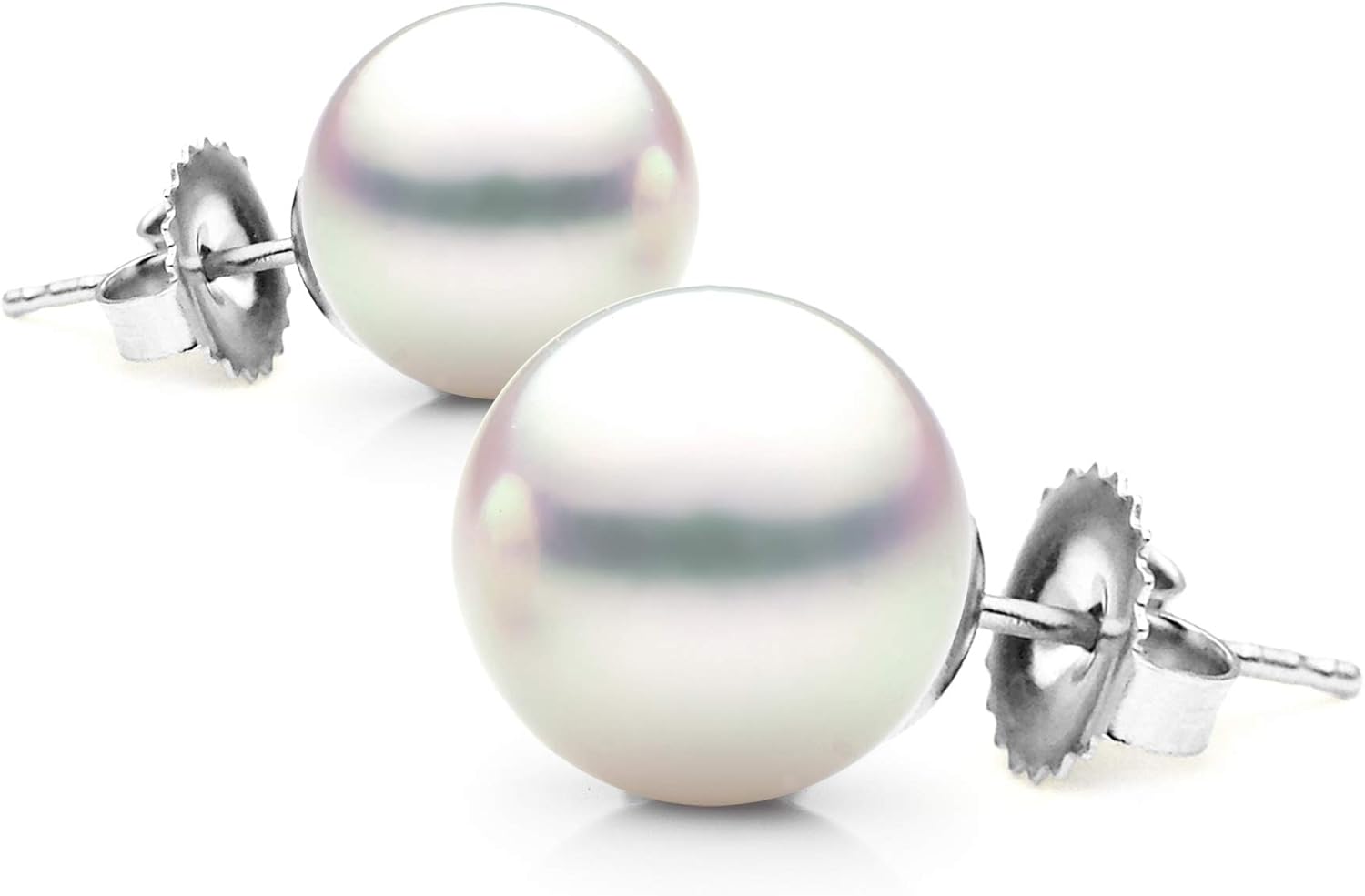
Akoya pearl stud earrings are the most recognizable pearl jewelry in the world — the small, round, white pearls with a mirror-bright shine that most people picture when they hear “pearl earrings.” They’re grown primarily in Japanese and Chinese saltwater oysters, harvested in sizes ranging from about 6mm to 9mm in diameter (roughly the size of a garden pea up to a small marble), and they sit at the core of the $120–$370 retail range that dominates online pearl shopping. If you’re buying a first pair or sourcing a batch for resale, that range sounds manageable — until you start comparing listings and realize that a $139 pair and a $320 pair can look almost identical in a product photo. This article breaks down exactly what separates them: the four quality factors that drive price, how grade labels are used (and misused), and the decision rules that help you buy with confidence rather than hope.
| EDITOR'S PICK[THE PEARL SOURCE Akoya Pearl Ea…](https://www.amazon.com/dp/B00M0Z337A?tag=greenflower20-20) | Mid-tier[AAAA Grade 5–10mm White Japanes…](https://www.amazon.com/dp/B00F4O037W?tag=greenflower20-20) | Budget pick[THE PEARL SOURCE Real Pearl Stu…](https://www.amazon.com/dp/B00LCI8VR8?tag=greenflower20-20) | |
|---|---|---|---|
| Pearl Grade | AAA | AAAA | AAA |
| Pearl Size | 6-6.5mm | 5.5-6.0mm | — |
| Metal Type | 18K Gold | 14K Gold | 14K Gold |
| Gold Color | Yellow | Yellow | — |
| Certificate | — | ✓ | — |
| Gift Box | — | ✓ | — |
| Price | $290.00 | $169.99 | $112.00 |
| See on Amazon → | See on Amazon → | See on Amazon → |
Why “AAA Akoya” Means Less Than You Think
Here’s the honest starting point: there is no universal, third-party-enforced grading standard for cultured pearl studs sold at retail. The GIA does publish a comprehensive pearl grading framework — outlined in their “Pearl Description and Grading” documentation at gia.edu — covering luster, surface quality, shape, color, and nacre thickness. But a retailer calling their studs “AAA” is using an internal or industry-convention grade, not a GIA-certified designation. The GIA grades individual pearls and strands on request; it does not issue standard lot grades that follow a product to market.
The Pearl Guide’s quality factor overview makes this point plainly: the AAA/AA+/AA scale is a trade shorthand adopted broadly but applied inconsistently. One vendor’s AAA is another vendor’s AA+. What matters is not the label but the underlying attributes — and whether the retailer is willing to describe them specifically.
What to ask instead of “what grade is this?”
- What is the nacre thickness? (Ideally stated in millimeters, not just “thick” or “excellent.”)
- What luster grade does the retailer use, and what does it mean? (Terms like “excellent,” “very good,” and “good” correspond to visible differences in reflectivity.)
- What surface quality tolerance does this lot carry? (How many visible blemishes per pearl, and of what type?)
- Is this Japanese Akoya or Chinese Akoya? (Both are saltwater Akoya, but provenance affects nacre deposition rates and finish expectations.)
If a listing can’t answer two or three of those questions specifically, the grade claim is filler.
The Four Attributes That Actually Drive Price in the $120–$370 Window
1. Luster — The One That Matters Most
Luster is the intensity and sharpness of light reflected off the pearl’s surface. A high-luster Akoya looks almost metallic — you can see a crisp reflection of a light source or your own finger. A low-luster pearl looks chalky or dull, like a white plastic bead with a slight glow.
The American Gem Society’s pearl buying guide describes luster as the single most important value factor in a cultured pearl, more impactful than surface perfection or even size within a given category. Pearl Paradise’s Akoya buying guide makes the same call: a smaller pearl with excellent luster outperforms a larger pearl with good luster at the same price point, in terms of perceived quality and long-term satisfaction.
In practical terms: if a product photo looks soft or milky even under studio lighting, the luster grade is likely AA or below. Crisp, bright reflection in a straight-on shot usually indicates AA+ or better. But photos are optimized — ask for a video or angled shot if you’re spending over $200.
2. Size — Where the Math Gets Interesting
Akoya studs at retail cluster around three size bands:
| Size | Typical retail range (pair, 14K settings) | Notes |
|---|---|---|
| 6.0–6.5mm | $120–$180 | Entry-level; clean and classic but visually modest |
| 7.0–7.5mm | $175–$270 | The sweet spot; noticeable on the ear without overpowering |
| 8.0–8.5mm | $250–$370+ | Premium band; nacre quality variance increases here |
Half-millimeter jumps carry real price weight because larger Akoya pearls are rarer — the oyster takes longer to deposit nacre, attrition rates are higher, and matching pairs is harder. The Pearl Source’s grading explainer notes that an 8mm Akoya with equivalent luster and surface to a 7mm can command 40–60% more per pair, simply due to size scarcity.
That math matters when you’re comparing listings: a $149 pair at 7.5mm and a $199 pair at 7.5mm are directly comparable on grade. A $149 pair at 7mm and a $199 pair at 7.5mm are not — you’re comparing size tiers, not grade tiers.
3. Nacre Thickness — The Long-Term Bet
Nacre (pronounced “nay-ker”) is the iridescent material the oyster layers around a nucleus bead to form the pearl. Thicker nacre means better luster, better durability, and a longer lifespan — thin-nacre pearls can chip or peel with regular wear, exposing the nucleus bead underneath.
The GIA’s grading documentation sets a minimum acceptable nacre thickness for quality Akoya at around 0.35mm, but top-tier Japanese Akoya in this price range typically carry 0.4–0.6mm. Chinese Akoya has improved significantly in the past decade but can still trend thinner at the lower price points, per consistent reporting from The Pearl Guide’s quality factor overview.
Nacre thickness is rarely listed in a standard retail product description. That omission is itself information. Vendors who specify it — “0.5mm nacre minimum” or “Japanese Akoya, thick nacre” — are signaling that they track it. Vendors who lead only with “AAA” and a photo may not.
4. Surface Quality — Tolerable vs. Distracting
No cultured pearl is blemish-free. The question is whether the surface imperfections (small pits, bumps, or faint scratches called “rings”) are visible from normal wearing distance — about 18 inches — and whether they affect structural integrity.
Pearl industry convention, as described by both The Pearl Guide and the American Gem Society, treats surface quality on a four-tier scale roughly equivalent to: clean to the eye (top), minor blemishes visible on close inspection, moderate blemishes visible at arm’s length, and heavy blemish. In a stud earring priced between $120 and $370, you should expect the top two tiers — anything in the moderate range at that price point is a grade mismatch.
For stud earrings specifically, surface quality is slightly less critical than for a necklace strand, because studs sit in a fixed orientation and the post-facing side is never visible. Some vendors match pairs with the cleanest surface facing forward. That’s a legitimate practice — ask whether it’s standard for the listing you’re evaluating.
Japanese vs. Chinese Akoya at This Price Point
This distinction trips up a lot of buyers, including experienced ones. Both are genuine saltwater Akoya pearls from the Pinctada fucata oyster species — there’s no fraud involved when a listing says “Akoya” without specifying origin. But the provenance does affect what you’re likely getting.
Japanese Akoya production has been declining for years, driven by environmental pressures and rising costs, per industry reporting across multiple pearl trade publications. The pearls that do reach market from Japan tend to carry thicker nacre and are harvested at cooler temperatures that deepen luster. They command a premium — sometimes 20–35% above comparable Chinese Akoya of the same stated size and grade.
Chinese Akoya has closed much of the quality gap at the AA and AA+ levels, particularly in the 6–7.5mm range. For buyers prioritizing value per millimeter of luster, a well-sourced Chinese Akoya pair at $150–$180 in the 7mm range can outperform a Japanese-origin pair at the same price if the Japanese product is carrying thin nacre or a lower surface grade.
The decision rule here: if origin matters to you for gift-giving or resale positioning, ask for it in writing. If you’re optimizing for quality at a given price, ask for nacre thickness and luster grade regardless of origin.
Reading a Listing: A Practical Checklist
Before you commit to any stud earring purchase in this range, run through this:
Green flags
- Size stated as a range (e.g., “7.0–7.5mm”) with measurement method noted
- Nacre thickness specified in millimeters
- Luster described with a specific term (“excellent,” “very high”) and a definition or photo context
- Origin stated (Japanese or Chinese Akoya)
- Return window of at least 30 days with no restocking fee
Yellow flags
- “AAA” with no attribute breakdown
- Size listed as a single number with no tolerance stated (pearls are organic; a “7mm” pair may run 6.8–7.2mm)
- Luster described only as “lustrous” or “bright” without comparative context
- Photos that look soft or heavily retouched
Red flags
- Price below $100 for 7mm+ studs in 14K gold settings (the metal cost alone makes this implausible for genuine Akoya)
- No mention of nacre, surface quality, or origin anywhere in the listing
- Grade claims like “AAAA” or “5A” — these don’t correspond to any recognized industry scale and are pure marketing inflation
The Decision Rule
If you’re buying for personal wear or as a gift in the $120–$200 range: prioritize luster over size. A 6.5mm pair with excellent luster reads as more refined than a 7.5mm pair with good luster — and it will hold up better over years of wear as the nacre ages.
If you’re sourcing for resale or a studio collection in the $200–$370 range: size and origin both matter for customer perception, but nacre thickness is your protection against returns and complaints eighteen months out. Push vendors for written nacre specs. If they can’t provide them, that tells you something about their supply chain knowledge.
If a listing grades high on marketing language and low on measurable attribute data, it’s not a deal — it’s a gap in the vendor’s accountability. At this price tier, you have every right to ask specific questions and receive specific answers before you pay.
Sources referenced: GIA “Pearl Description and Grading” overview at gia.edu; The Pearl Guide “Akoya Pearl Quality Factors” at pearlguide.com; American Gem Society “How to Buy Pearls” at americangemsociety.org; Pearl Paradise “Akoya Pearl Buying Guide” at pearlparadise.com/blogs; The Pearl Source “Pearl Grading: What AAA Really Means” at thepearlsource.com/blog.