May 29, 2026 • Steve Dawson • 9 min reading time • Prices verified June 25, 2026
Akoya Pearl Jewelry Sets: When Buying the Full Suite Beats Piecing It Together
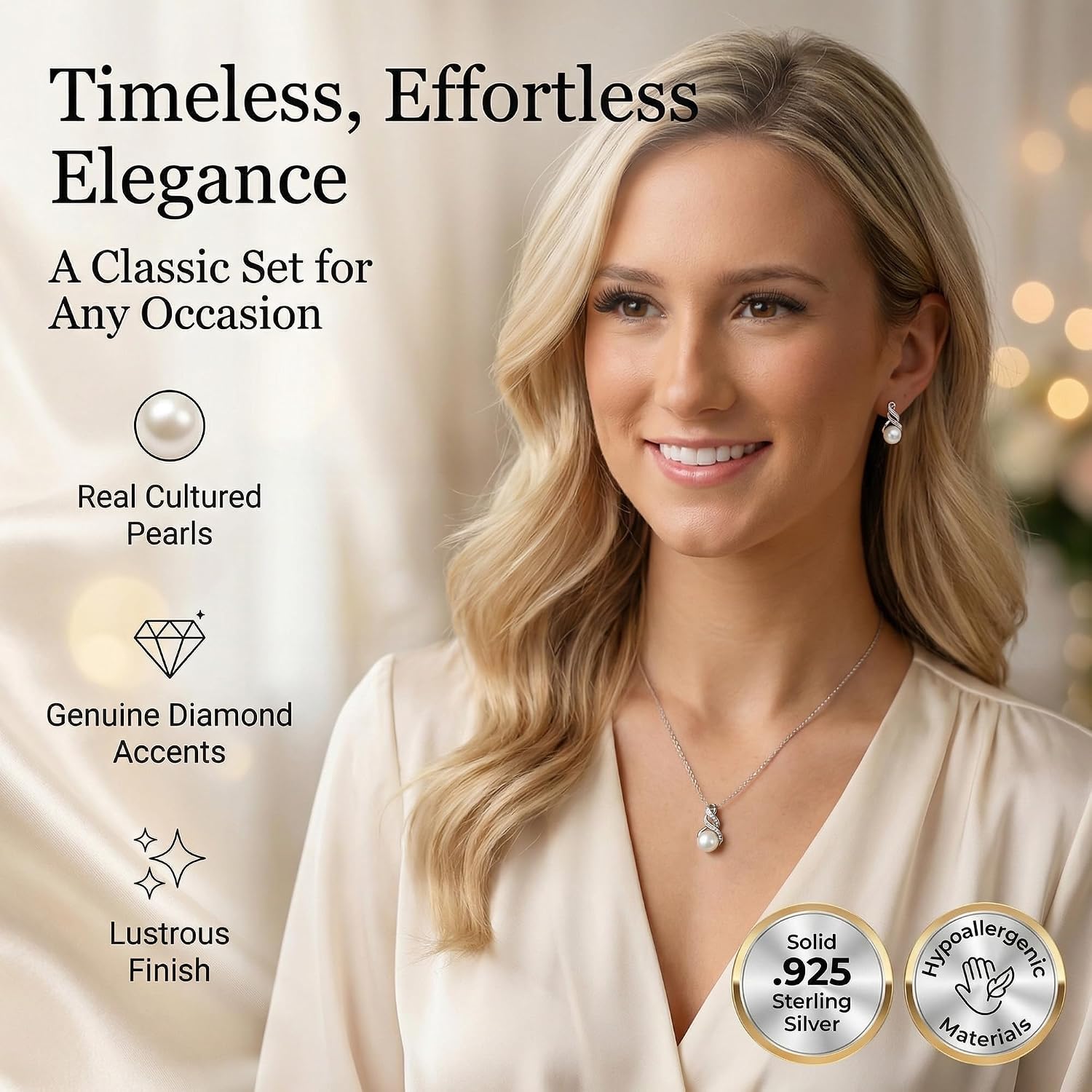
You’re considering an Akoya pearl necklace — and now you’re wondering whether to add matching earrings and a bracelet at the same time. That’s the core question this article answers. Akoya pearls (AH-koh-yah) are saltwater cultured pearls grown primarily in Japan and China, prized for their sharp, mirror-like luster and round shape. A “jewelry set” just means a matched suite: necklace, earrings, and sometimes a bracelet or ring, all graded from the same pearl harvest so the color, size, and surface quality line up consistently. Matching matters more than it sounds — pearls from different lots, even from the same retailer, can differ visibly in overtone or luster once you put them side by side on skin. This guide walks through the real price math, the quality matching problem, and the specific situations where committing to the full suite upfront is the smarter move versus building piece by piece.
The Matching Problem Nobody Warns You About
Here’s the issue practitioners hit on their second or third pearl purchase: pearls are biological. Even two strands graded AAA from the same farm in the same harvest year can differ in rose overtone intensity, nacre depth, or surface cleanliness once you hold them under the same light source.
The GIA’s pearl grading standards (documented in GIA’s Pearl Description and Grading Standards) evaluate luster, surface quality, shape, color, and nacre quality as separate axes. A strand graded AAA on luster can still sit on the cooler end of the rose-overtone spectrum relative to another AAA strand graded in a separate lot. Neither is misrepresented. They just don’t match.
When you buy a necklace today and return six months later for earrings, two things have changed:
- The retailer’s current inventory is from a different lot.
- Your original necklace has spent six months in ambient light and humidity, shifting its surface appearance slightly relative to brand-new pearls.
Retailers who specialize in matched sets solve this by pulling necklace, earrings, and bracelet from a single curated lot — or from adjacent lots they’ve already confirmed match under controlled lighting. Pearl Paradise’s buying guides note that matched sets are graded as a unified collection, with strand-to-earring color consistency verified before packaging. That process costs the retailer labor. It’s why sets carry a premium on paper — but often less than the cost of two separate custom-matching requests later.
The American Gem Society’s pearl quality guidance reinforces this: consistent overtone across pieces in a suite is a function of lot selection, not just grade designation. Grade alone does not guarantee visual match across pieces purchased at different times.
The Real Price Math: Set vs. Piecemeal
Let’s put numbers on it. These are representative 2026 retail ranges based on published pricing from major Akoya specialists. Your specific numbers will shift by brand, size, and grade — but the ratios hold.
By the numbers: 7mm AAA Akoya, rose/white, high luster
| Purchase path | Approximate retail range |
|---|---|
| Necklace only (16–18 in.) | $280–$480 |
| Stud earrings, matched separately (6 months later) | $140–$220 |
| Bracelet, matched separately (6 months later) | $160–$260 |
| Piecemeal total | $580–$960 |
| Full suite purchased together | $420–$680 |
The set discount typically runs 15–25% off the sum of individual pieces, according to published pricing structures at The Pearl Source and Pearl Paradise. That’s not a promotional trick — it reflects the retailer’s reduced labor for matching, lower packaging cost per unit, and the fact that they’re moving inventory volume on a single transaction.
At the 7mm tier ($150–$500 range), that discount is the difference between a $550 purchase and a $700 purchase for the same quality. At the Hanadama-certified or premium South Sea tier, the math scales: a set discount on a $3,000 necklace suite can represent $600–$900 in real savings.
The counterargument: you pay the full set price upfront. If cash flow is a constraint, or if you’re genuinely unsure whether you’ll want the bracelet, locking into the full suite isn’t automatically right. More on that in the decision rules below.
Where Grade Differences Actually Show Up in Sets
Not all set mismatches are dramatic. Some are invisible in photographs and only apparent in person. This is the part that catches intermediate buyers off guard — because online retailers, even excellent ones, photograph pearls under controlled studio lighting optimized to show luster at its best.
The Gem Society’s documentation on Akoya cultured pearl quality factors identifies three visual attributes most likely to diverge across separately sourced pieces:
1. Rose overtone saturation. Akoya pearls are graded for their characteristic rose (sometimes called “rosé”) overtone layered over a white or cream body color. This overtone ranges from barely perceptible to distinctly pink. Two AAA strands can sit at opposite ends of that range.
2. Luster sharpness. Luster in pearls refers to how crisply a reflected light source appears on the surface — the sharper and more defined the reflection, the higher the luster grade. A necklace with sharp, high-contrast luster will visually outshine a matching earring pair with softer, slightly diffused luster even if both are technically graded “excellent.”
3. Surface cleanliness uniformity. Surface quality grades describe the distribution of natural blemishes (spots, ridges, bumps) across the pearl’s surface. A strand graded AA+ might have one or two minor surface marks on less-visible pearls. Earring studs, by contrast, show their entire surface face-forward. An earring graded AA+ to match an AA+ strand can still look less clean in direct comparison if its visible face carries more marks than the strand’s most-visible pearls.
Buying from a set eliminates these variables because the retailer has already done the visual reconciliation. Buying piecemeal transfers that reconciliation work to you — and if you’re purchasing online, you may not catch a mismatch until both pieces arrive and you hold them together under your own light source.
Per The Pearl Source’s educational content on pearl grading, this is one of the primary reasons experienced buyers request “lot-matched” sets rather than assembling individual pieces, even at equivalent grade designations.
When Piecemeal Is the Right Call
The set-beats-piecemeal argument has real limits. Here are the specific situations where buying individual pieces is the correct move:
You already own a necklace you love. If you have an existing Akoya strand — especially one with sentimental history or a strong grade — the right move is to bring that necklace to a retailer (or photograph it carefully in neutral daylight) and request earrings matched to it specifically. Good pearl specialists can work from photos with reasonable accuracy at the AA+/AAA tier. Pearl Paradise and The Pearl Source both offer this kind of matching service for existing pieces, per their published service descriptions.
You want different pearl sizes in different pieces. Graduated necklaces, larger earring studs than the necklace’s center pearls, or a tennis bracelet in a smaller diameter than the necklace — these are valid aesthetic choices that sets can’t accommodate. If you’re designing to a specific look rather than a uniform suite, piecemeal sourcing with a detailed matching brief is the right approach.
Budget is staged intentionally. Some buyers correctly stage their purchases: necklace now, earrings at a future milestone, bracelet as a gift years later. If each purchase is planned as a standalone acquisition — with the understanding that visual matching is a secondary priority — piecemeal works fine. The risk only materializes if you expect the pieces to look like they came from the same harvest. If you don’t, the matching problem is irrelevant.
You’re sourcing for resale or design. If you’re a studio designer or boutique importer, you’re likely sourcing loose strands and individual components from wholesale suppliers evaluated against GIA grading standards, not retail sets. The set premium doesn’t apply to your purchasing context. What applies instead is lot-consistency documentation from your supplier — which is the wholesale equivalent of what retail sets guarantee.
The Decision Framework
Here’s where this lands as a clean if-then decision rule:
If you’re buying for personal wear or as a gift and you want the pieces to visually match in real-world conditions — then buy the full suite from a single retailer in a single transaction. The 15–25% set discount is real, the matching guarantee is worth more than the discount at the premium tier, and the alternative (piecemeal matching later) is both more expensive and less reliable.
If you already own a necklace and want to add to it — then contact your original retailer first. Ask whether they can lot-match new pieces to your existing strand. If they can’t, find a specialist who offers explicit matching services rather than hoping grade designations will align visually.
If your primary driver is budget staging — then piecemeal is fine, but set your expectations accurately. You’re accepting some visual inconsistency risk in exchange for payment flexibility. At the 7mm AA tier, this risk is lower because the pearl characteristics are less distinctive and differences are harder to perceive. At the Hanadama or top-AAA tier, where every attribute is maximized, the inconsistency risk is higher because the differences between lots are more visible precisely because the pearls are so refined.
If you’re sourcing as a designer or importer — then the retail set framework doesn’t apply to you. Your decision unit is the lot, not the set. Focus your matching energy on supplier lot documentation and your own side-by-side visual verification before committing to a full order.
One number worth keeping in mind as a sanity check: the American Gem Society’s pearl quality guidance suggests that luster is the single most important quality factor in Akoya pearls, accounting for the largest share of value differential between grades. When in doubt about whether a set is worth the premium, lead with luster match. If the necklace and earrings reflect light identically in person, the rest of the matching variables matter much less. If the luster tone diverges — one mirror-sharp, one slightly hazy — no amount of surface-grade alignment will make the set look cohesive.
Buy the suite when the math and the matching both point the same direction. They usually do.